
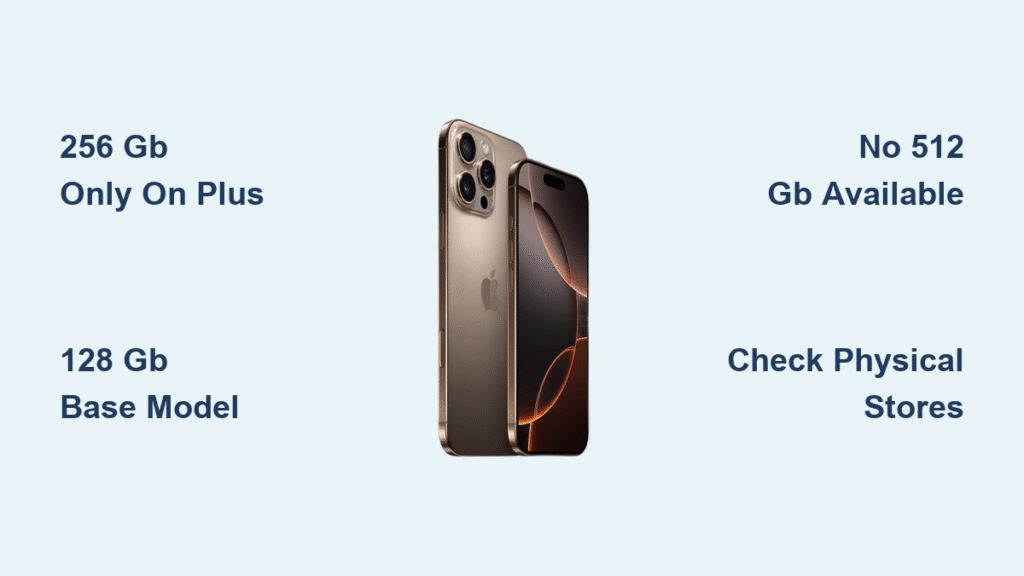
That moment when you confidently click “256 GB” on Apple’s iPhone 16 page only to see “Not available with more storage”? You’re not imagining it. Apple permanently axed all iPhone 16 storage options above 128 GB from its official store following the iPhone 17 launch, catching thousands of shoppers off guard. If you need more than base storage but can’t justify iPhone 17 pricing, your options have just narrowed dramatically—and the clock is ticking on remaining stock. This guide cuts through the confusion with exactly where to find higher-capacity iPhone 16 models today, why Apple made this move, and whether 128 GB will actually work for your daily usage.
iPhone 16 Storage Availability: What You Can Actually Buy Right Now
Standard iPhone 16: Trapped at 128 GB From Apple
Apple now forces all standard iPhone 16 buyers into 128 GB storage at $699. Attempting to select 256 GB or 512 GB triggers an immediate block with “Not available with more storage” messaging—no exceptions. While third-party retailers like Best Buy and Amazon list higher tiers, real-time inventory tags consistently show “Out of Stock” or “Subject to availability.” Any visible “In Stock” listings typically disappear within hours as residual units get snapped up.
iPhone 16 Plus: Your Last Official 256 GB Lifeline
The Plus model remains the only Apple-sanctioned path to 256 GB storage without upgrading to iPhone 17. You’ll pay $100 more than the base model ($899 vs $799 for 128 GB), but crucially, this tier still ships directly from Apple with full warranty coverage. The 512 GB variant? Officially dead—no manufacturing, no restocking, and carrier sites like Verizon explicitly mark it “Out of stock” with no estimated return.
Pro Models: Completely Gone From Every Channel
Don’t waste time searching. Both iPhone 16 Pro and Pro Max vanished entirely after iPhone 17’s debut. Apple’s website, carrier stores, and even gray-market dealers show zero legitimate inventory. Your only Pro upgrade path now requires paying iPhone 17 Pro prices.
Hunting Down Scarce 256 GB & 512 GB Units: Where to Look Today
Physical Retailers Beat Online Stock Indicators
Online “Out of Stock” labels lie. Major retailers often have unlisted shelf stock because:
– Warehouse clubs like Costco receive bulk shipments that sit in backrooms for weeks
– Carrier stores (Verizon, AT&T) frequently hold unsold units not reflected online
– Big-box electronics sections at Target or Walmart get sporadic deliveries
Pro move: Call five local stores before visiting. Ask: “Do you have any sealed iPhone 16 units in 256 GB or 512 GB?” Staff can check backrooms instantly—online systems lag by 24+ hours.
Third-Party Marketplace Red Flags
Amazon and Newegg listings showing “In Stock” for 256 GB/512 GB often hide critical details:
– Prices inflated $50–$150 above original MSRP ($799 → $949)
– “Renewed” or open-box units mislabeled as “new”
– Voided warranties if sold by unauthorized resellers
Verify before buying: Demand original receipt, unbroken seal, and Apple-authorized seller status. If the listing avoids these details, walk away.
Why Apple Killed Higher iPhone 16 Storage Options

Strategic Product Line Squeeze
Apple’s removal of 256 GB/512 GB from standard iPhone 16 serves two ruthless purposes:
1. Eliminating iPhone 17 overlap: All iPhone 17 models start at 256 GB, so keeping higher iPhone 16 tiers cannibalized new sales
2. Forcing tiered upgrades: Budget users get stuck with 128 GB iPhone 16, while anyone needing more must now pay $899 for iPhone 16 Plus 256 GB or jump to iPhone 17’s $799+ starting price
Manufacturing Efficiency Wins Over Customer Choice
Fewer storage SKUs mean Apple avoids:
– Complex component forecasting for multiple flash memory configurations
– Leftover inventory when iPhone 17 launched
– Production line retooling between storage variants
The result? Apple slashed from six possible iPhone 16 storage combinations down to just three across its entire lineup—a pure cost-saving move that sacrifices user flexibility.
iPhone 16 Storage Decision Guide: 128 GB vs 256 GB vs iPhone 17

Stick With 128 GB iPhone 16 Only If…
- You stream 90%+ of music/video (Spotify, Netflix, Disney+)
- Use iCloud Photos with “Optimize iPhone Storage” enabled
- Install under 50 apps total (check Settings > General > iPhone Storage)
- Never shoot 4K ProRes or 48 MP ProRAW photos
Reality check: 128 GB fills fast with just 20 large games (like Genshin Impact at 20 GB each) or 4K video projects. System files alone consume 25 GB out of the box.
Jump to iPhone 16 Plus 256 GB When You…
- Download movies for flights (a single 4K film = 15 GB)
- Shoot 4K video regularly (1 minute = 350 MB)
- Use offline navigation maps (Google Maps regions = 2–4 GB each)
- Prefer local photo storage over iCloud dependency
Critical note: The Plus model’s 256 GB is your last chance for this capacity without iPhone 17 pricing. Once current stock depletes (likely by December), it’s gone forever.
iPhone 17 Becomes Mandatory For…
- 512 GB or 1 TB storage needs
- Latest camera features (periscope zoom, enhanced low-light)
- ProMotion display (120Hz refresh rate)
- Titanium chassis (lighter weight, premium feel)
Technical Truths About iPhone 16 Storage
Why You Can’t Expand Storage Later
All iPhone 16 models use soldered NVMe PCIe flash storage—completely non-expandable. No microSD slot exists, and Apple’s USB-C port (despite supporting 10 Gbps transfer speeds) won’t bypass this limitation. Backing up 128 GB to a computer takes ~15 minutes, but you can’t run apps or photos directly from external drives.
iCloud Isn’t a True Storage Replacement
iOS 18’s “Optimized Storage” automatically offloads original photos when space runs low, but this creates critical vulnerabilities:
– No offline access to offloaded content during flights or poor signal areas
– 30-day music purge: Lossless Apple Music downloads vanish after a month of inactivity
– App archive risks: Unused apps get removed, potentially losing in-app progress
Warning: Relying solely on iCloud requires consistent high-speed internet—a dangerous gamble for travelers or rural users.
Smart Buying Checklist Before You Click “Purchase”
Verify Your Actual Storage Needs First
- Open Settings > General > iPhone Storage on your current device
- Check “Large Apps” and “Videos” sections—these dominate space
- Note how many 4K videos you keep locally (each minute = 0.35 GB)
Confirm Physical Stock Before Paying Premiums
- Call three physical stores within 10 miles
- Ask: “Do you have sealed 256 GB iPhone 16 units on your sales floor right now?”
- Demand original receipt if buying online to avoid refurbished units
Calculate True Cost vs. iPhone 17
A “discounted” $899 256 GB iPhone 16 Plus may cost more than waiting for iPhone 17 Black Friday deals. Compare:
– iPhone 16 Plus 256 GB: $899 (no future trade-in value)
– iPhone 17 128 GB: $799 (but requires $100 more for 256 GB)
– Math tip: Factor in $50–$100 annual trade-in depreciation for older models
Act Now or Lose Higher iPhone 16 Storage Forever
Apple’s iPhone 16 storage cutoff isn’t a glitch—it’s a permanent strategy to push buyers toward newer models. The 256 GB and 512 GB variants won’t return, and remaining third-party stock will vanish before Christmas. If you need more than 128 GB, your only viable paths are:
– iPhone 16 Plus 256 GB ($899) for immediate Apple-backed purchase
– Scour physical retailers today for residual 256 GB/512 GB stock (call before driving)
– Wait for iPhone 17 deals if you can survive with 128 GB temporarily
For most users, 128 GB remains sufficient if you embrace streaming and iCloud—but power users capturing 4K video or installing massive games will hit limits within months. Don’t gamble on “finding stock later.” Check Settings > iPhone Storage right now, then either lock in 256 GB today or accept 128 GB’s constraints. The higher-capacity iPhone 16 window is closing faster than Apple’s support pages suggest—and once it shuts, you’ll pay iPhone 17 prices for the storage you need.
